|
Kia Ora Member,
Two weeks of historic Safe Staffing strikes at Te Whatu Ora concluded yesterday. The purpose of the strikes was, alongside previous full withdrawals of labour, to continue to put pressure on Te Whatu Ora and the Government to respond to our bargaining claims and agree to concrete steps that will fix chronic and ongoing understaffing in our hospitals.
In this Kaitiaki story Whangārei emergency nurse and delegate Rachel Thorn shared what many NZNO members experienced through the strikes - that withdrawing all labour outside of normal shifts and workplaces revealed dangerous practices that had been relied on for years including calling in theatre nurses early and deploying nurses with no specialist knowledge into areas such as orthopaedics or neonatal.
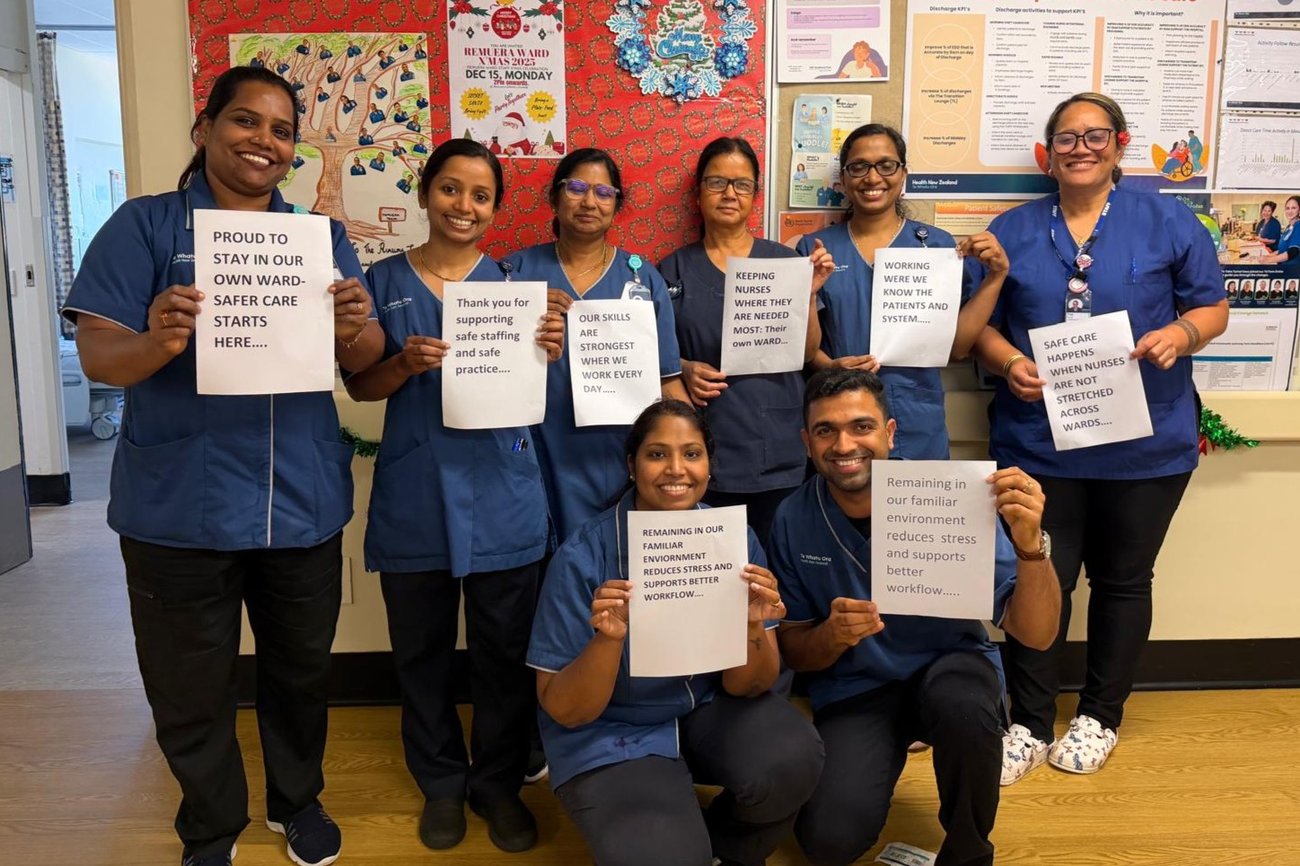
Members (including those in Remuera Ward at Auckland Hospital, pictured above) told us of their surprise at having good shifts where they were able to spend time caring for their patients as needed instead of being redeployed to another area.
Members also told us that the Safe Staffing strikes have given them renewed confidence to use existing workplace processes through CCDM and the legal safe staffing provisions to push back against unsafe staffing. More about this below.
A special thank you to all those delegates and members who took leadership in their worksites through the strikes. This includes the delegates on call and meeting daily or 72 hourly with Te Whatu Ora to ensure the LPS process went smoothly. Also to the national delegates who assisted with daily member and delegate zooms as well as assisting with local LPS on worksites - thank you for going above and beyond.
In the background, the NZNO bargaining team has continued to meet with Te Whatu Ora to try and progress this situation. There will be additional bargaining dates before Christmas. As always, members will be immediately advised if there is anything to report.
Looking ahead, through December and January NZNO will raise awareness of chronic and unaddressed short-staffing through a series of hard-hitting media stories. We have been gathering data, evidence and anecdotes which tell compelling tales of the issues faced by NZNO members.
If you are keen to do local actions over this period, you could also consider what your colleagues in Christchurch and Waitematā have done with their recent uniform and poster visibility strikes. These have been effective and fun for members to take part in.
Possible next steps for national collective action, should it be necessary, will be discussed with members in the new year.
Debriefing LPS during the Safe Staffing strikes
A debrief process of the Safe Staffing strikes will now get underway.
Initial analysis from NZNO data shows that about 40 per cent of LPS requests received in this strike were not legitimate. Your feedback and further auditing of LPS requests that will be carried out this week will be critical.
NZNO proposed having a pool of named staff available to respond to any request for LPS but Te Whatu Ora refused in 19 districts. How would this have affected LPS during the strikes?
Survey links for members, delegates and District Nurse Managers will be sent out shortly.
In addition, NZNO delegates and NZNO members who are District Nurse Managers are invited to attend online debrief sessions on Tuesday 2 December and Thursday 4 December.
Online debrief sessions for NZNO delegates
-
Tuesday 2 December, 4-5pm
Join by Zoom here
Meeting ID: 608 440 9122
Passcode: 123456
-
Thursday 4 December, 10-11am
Join by Zoom here
Meeting ID: 608 440 9122
Passcode: 123456
Online debriefs for NZNO members who are District Nurse Managers
-
Tuesday 2 December, 10-11am
Join by Teams here
Meeting ID: 484 633 459 900 77
Passcode: Cy97XR3Y
-
Thursday 4 December, 9-10am
Join by Zoom here
Meeting ID: 608 440 9122
Passcode: 123456
Take action for Safe Staffing - use VRM/VIS traffic lights every time you are short staffed
The CCDM VRM system includes a traffic light system to indicate the level of unsafe staffing in each ward and a Standard Operating Procedure (SOP) that steps out actions that should be taken to ensure the rapid return to safe staffing and protection of patient care. By following every step of the SOP, staff can accurately assess workload, escalate concerns, and ensure that risks are managed consistently.
It is critical that employees hold their employer accountable for responding to VIS yellow and orange alerts, as these signal rising staffing pressure and potential patient risk that require timely action. VIS red must be avoided at all costs because it represents unsafe conditions with a high potential for patient harm.
Using the VRM system properly safeguards both patients and staff, ensures transparency, and reinforces a culture of safety and accountability in health care. The flowchart provided by NZNO as a supportive resource for Te Whatu Ora nurses in the Safe Staffing strike reminds nurses that VRM tools provide an important safety alert system that should not only be used in strike action but used every shift, on every ward every day to protect both nurses and their patients.
If the workplace is unsafe - using legal provisions
The Health and Safety at Work Act allows for workers to respond to situations of imminent danger by ceasing unsafe work. You can read the relevant section of the Health and Safety at Work Act here.
If workers believe their workplace is unsafe but the situation is not one of imminent danger, there are other avenues available to act collectively in order to resolve this with the employer. More information here. You can also contact the NZNO Member Support Centre or your organiser to discuss further.
Building our power
Make sure everyone in your work area who can be an NZNO member is with us. The link to join is here.
Ngā mihi,
Paul Goulter, Chief Executive Officer
Tōpūtanga Tapuhi Kaitiaki o Aotearoa NZNO
|