|
|
|
Member Newsletter/Pānui 10 April 2026 |
|
|
|
|
|
Kia ora members,
The funding of our essential public services – especially our public health system – will be a key focus for voters in November’s general election. Public opinion polling consistently finds health is the second biggest concern for New Zealanders, behind only the cost of living.
One of the most powerful moments for NZNO last year was when we joined with other essential public service unions for the 23 October Mega Strike. This year the unions, including those representing teachers, doctors, government workers and firefighters, will join forces again on International Workers’ Day on Friday 1 May.
This is a chance to highlight the under-resourced health sector, and backward industrial policies of the Coalition Government which have reduced workers’ rights and, along with changes to health and safety legislation, will make workers less safe on the job.
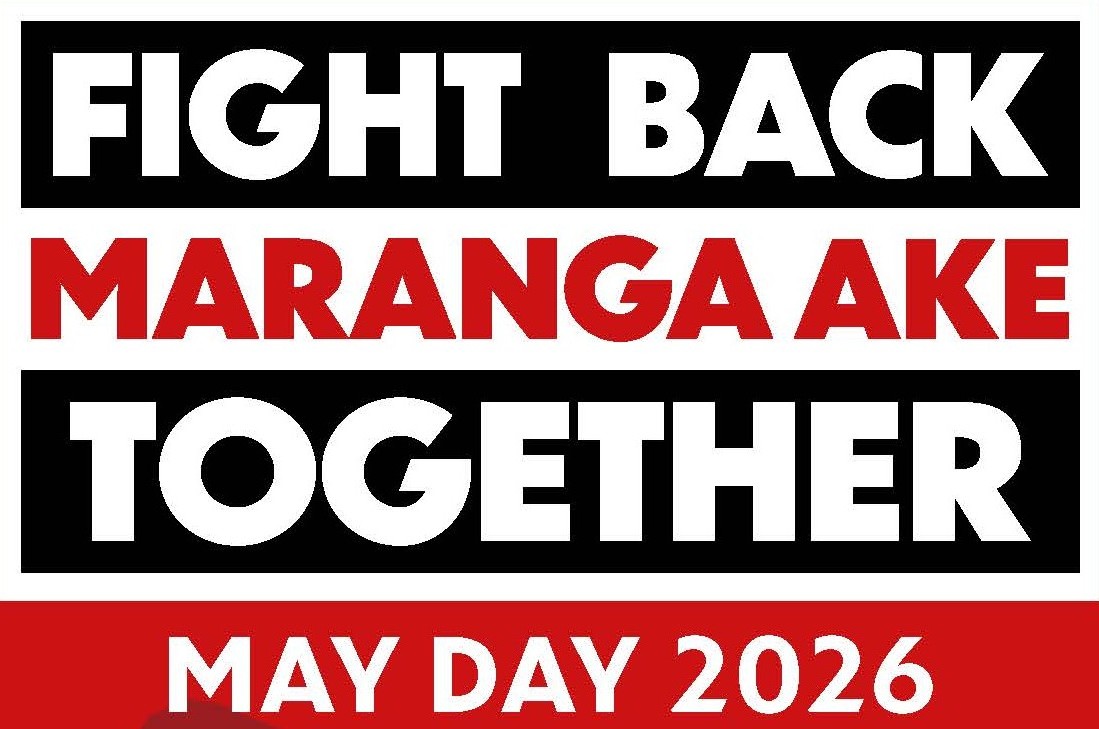
Fight Back Together Maranga Ake events will be held across Aotearoa New Zealand with two events, on the West Coast and in the Wairarapa, held the following day. NZNO is leading events in Whangārei, Auckland and Wellington.
For some members, notices for release under Section 26 of the Employment Relations Act will be issued so you can attend your local hui. Please see more on this below.
Local Organising Groups gear up
Our new Local Organising Groups (LOGs) are now largely confirmed, and some have had initial meetings. LOGs replaced the former regional councils and were established following the adoption of the new NZNO constitution last year.
At most localities, the former regional council chair has been appointed as the interim LOG chair. They are now working with their assigned NZNO organiser to bring together local member leaders. The aim is that eventually each LOG will include workplace delegates from the five health sectors (Te Whatu Ora, primary health, private hospitals and hospices, aged care and the Māori and Iwi providers), the local Te Poari member, any known local College and Section committee members, any National Delegates Committee members and any local National Student Unit reps.
These new LOGs are an opportunity for members to have greater and more cohesive input into NZNO's direction, strategy and decision-making at a national level. Further information about the LOGs will be distributed as details are finalised.
Te Whatu Ora bargaining team in safe staffing talks
The new safe staffing joint subcommittee has been set up and will met next week.
The aim of this group is to find a way forward on enforceable safe staffing and nurse to patient ratios, as well the employment of all nurse graduates.
The NZNO bargaining team and Te Whatu Ora have agreed to this step in the hope that having smaller groups dedicated to address specific issues may enable the impasse to be broken. We also note there are significant other issues which also remain to be addressed.
Senior designated nurses
NZNO today initiated collective agreement bargaining with Te Whatu Ora for senior designated nurses. This follows an anomaly which meant any senior nurse above grade 6 on the current collective had to be on individual employment agreements. This included positions such as directors and associate directors of nursing and midwifery. It also meant these very senior nurses couldn’t access entitlements that all other nurses on the main Te Whatu Ora collective received.
Needless to say, senior nurse delegates have welcomed this development and are looking forward to working with their employer to right this wrong.
Waitematā district nurses take a stand
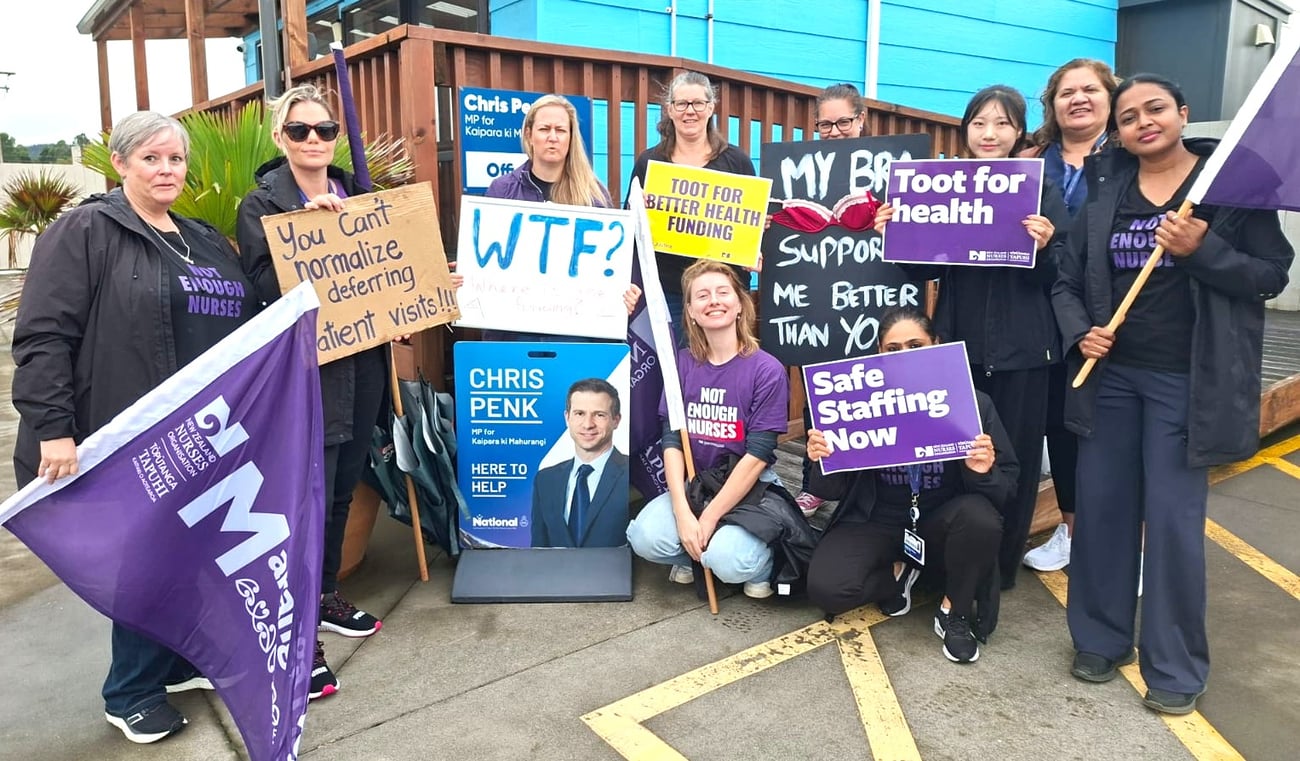
Meanwhile, ongoing frustration over chronic short-staffing saw Waitematā district nurses walk off the job for 12 hours on Wednesday. The group of 63 members provide care to hundreds of homebound patients every day across west Auckland’s Waitākere, North Shore, Wellsford and Hibiscus Coast.
They spent Wednesday picketing outside the Auckland electorate offices of Health Minister Simeon Brown, and his Cabinet colleagues Mark Mitchell and Chris Penk. See photos below.
Chief Nurse Nadine Grey told the Kaitiaki nursing magazine Te Whatu Ora had set up a working group to consider the next steps in its review of district nursing services. This was news to NZNO and we look forward to being included in this work.
Fuel crisis preparations
NZNO attended a briefing from Te Whatu Ora to unions yesterday on their plans to handle the fuel crisis and potential restrictions outlined in the Government’s NZ Fuel Plan.
New Zealand is currently at Level 1 and so there are no restrictions in place other than common sense advice to defer any non-essential travel and hold online meetings wherever possible.
Te Whatu Ora believes that, if required, health sector workers would be a priority for accessing fuel. They are also looking at options around better utilisation and prioritisation of their electric vehicle fleet. As some employees have to use their own vehicles to travel to see patients, unions requested reimbursement of these costs be expedited because they now are much higher.
There were also concerns raised about patients being able to access health services and travel to appointments, as well as what support health workers would receive in terms of their attendance at work. This has the potential to significantly impact our members’ ability to get to work.
Stay safe this weekend
Finally, from me this fortnight, you are no doubt aware of the red weather warnings for the North Island as Cyclone Vaianu approaches. Please make sure you and your whānau are prepared and follow the advice from the National Emergency Management Agency.
Batten down the hatches and stay safe everyone.
Ngā mihi,
Paul Goulter, Chief Executive
Tōpūtanga Tapuhi Kaitiaki o Aotearoa NZNO
|
|
|
|
|
|
In this member newsletter |
|
|
|
|
 |
|
Waitākere Hospital district nurses express their frustrations outside Chris Penk’s electorate office in Auckland on Wednesday.
From left to right are: Sheryl Reid, Rosanne Maber, Alicia August, Lynn Harrison, Julianne Byles, Chloe, Judy, Anumol Babura, Rachel Davis and Sumeet Sandhu.
Maranga Ake! Fight Back Together May Day Hui on 1 May
On 1 May join with union members at hui across the country and show this year nurses, midwives, health care assistants and all kaiawhina hauora will be voting for the future of our public health system. Please check the official website for the most up-to-date information and find out more: Fight Back Together Maranga Ake
NZNO members need to be at the May Day hui alongside other working people to send a strong message to those in power. Stand together for our public health system, for fairness and for Te Tiriti.
In some cases, notices for release under Section 26 of the Employment Relations Act will be issued for NZNO members to attend their local hui. Your organiser will advise you if a Section 26 notice has been issued for your worksite.
Otherwise, if you are not rostered to work at the time of your local hui please attend if you are able to.
Friday 1 May
- Whangārei: Laurie Hall Park, 12-1pm
- Auckland: Domain Drive North, 12-1pm
- South Auckland: Manukau Plaza, 12-1pm
- Hamilton: Civic Square (behind Garden Place), time TBC
- Tauranga: Location TBC, 12-1pm
- Gisborne: Heipipi Park, 12-1pm
- Rotorua: Location and time TBC
- New Plymouth: Huatoki Plaza, 12-1pm
- Hawkes Bay: Napier - Market St, Hastings - Albert Square, 12-1pm
- Palmerston North: Arena 5 - Barbers Hall, 12-1pm
- Wellington: Wellington Hospital-Newtown School, 7am
- Wellington: Cuba Mall, 12-1pm
- Nelson: 1903 square/ Church steps, time TBC
- Greymouth: Monteiths Bar Annex, 3.30-4.30pm
- Christchurch Central: Bridge of Remembrance, 1-2pm
- Christchurch: Addington Raceway, 12-1pm
- Dunedin: Union Hall Otago University, 12.30-1.30pm
- Invercargill: Southland Stadium, 1-2pm
Saturday 2 May
- Masterton: Queen Elizabeth Park, 11:30am-1:30pm
- West Coast: Blackball Hotel, Debate and Dinner, 4pm
|
|
|
|
|
This week we signed the new collective agreement for Access Community Health. The documents came through on Tuesday and were checked and signed on Wednesday.
As the process of ratification and signing was completed before the 10 April deadline, everything will be processed through payroll by 30 April, and the new pay rates are applicable from 8 April.
This collective agreement contains some great progress for Access nurses, thanks mainly to the dedication of the delegates elected to the bargaining team and their willingness to fight for real improvements to pay and conditions.
Prior to this bargaining round, Access pay and conditions were among the worst in the sector, a position that Access claimed they were “very comfortable with”. On ratification, the member voted very strongly in favour of the offer, which had taken ten days of negotiations and two full day mediations to achieve.
Previous collectives at Access had low pay, with progression on the pay scale only “once during the life of the collective” and a history of very difficult and protracted negotiations, including industrial action, mediation and even facilitation in the Employment Relations Authority. This combination meant that nurses with 6+ years of service were still on step 3 of their pay scale, awaiting another long round of negotiations to advance one pay step. There was also no PDRP or merit system for nurses, inconsistent application of on-call pay, and no long service recognition, even though the average length of service was very low thanks to a 25%+ turnover rate due to no incentive to stay with poor pay and conditions. Thanks to our wonderful, hardworking delegates, Access members now have:
Automatic progression on the pay scales on the anniversary of employment
- Consistent on-call payments
- Long Service Leave
- PDRP system introduced with a start date and an allowance written into the CA
- A two-year term with two 3% pay increases
- Recognition of previous relevant service on appointment, with the ability to bring PDRP from other employers for 12-months from commencement
We are aware that the Total Care nurses, who have the same owners and CEO and the same bargaining advocate, have not been offered anywhere near the Access offer. Negotiations continue at that employer and we’re hopeful that they manage the same improvements that the Access team have managed to secure.
We have met with employer advocates for the PHC MECA and have had preliminary discussions with them about how to approach bargaining this time around. We have made a couple of suggestions to improve the process and eliminate the delays and disputes we saw last time around and meet them again next week to hear their responses. Regardless of the outcome of these discussions, we will be surveying members soon on proposed claims to raise and seek nominations to the bargaining team.
Corrections have made a start on the working parties agreed at the last bargaining round. We have also spoken to them quite firmly about their lack of consultation on some issues and local changes, where they had consulted with CANZ and PSA but forgotten they have a health team represented by NZNO.
We’re also working with Corrections on the introduction of the Kronos pay system, which will mean issues with payroll such as multiple pay errors and delays in getting penals and on-call payments will be eliminated once implemented fully. We have asked some difficult questions of their proposed rostering and pay changes linked to the Kronos transition which has resulted in us and Corrections agreeing to form a short working group with appropriate experts made available to remove obstacles and provide clarity on the system’s implementation. |
|
|
|
|
Pay equity in the non-Te Whatu Ora sector |
|
|
|
|
Pay Equity Update: Who is carrying the cost?
Pay equity is often framed as a cost to Government, but across the wider health system, that cost has already been absorbed by the workforce.
Members have held services together through rising demand, higher acuity, and ongoing staffing pressure. That work has sustained healthcare and avoided greater system failure, keeping services running in conditions that continue to tighten.
Those savings have come at a price, carried in workload, burnout, and the growing gap between what the work requires and how it is recognised. The system has relied on that gap, on skilled, predominantly female workforces continuing to deliver under increasing strain, often without the recognition that reflects the true value of the work.
Over the coming weeks, NZNO members at BUPA will vote on whether to raise a pay equity claim for aged care nursing. Some members, including many health care assistants in aged care, are now locked out of raising claims. Where access remains, it matters that we use it. This is a crucial step using the access we still have to progress a claim, test the system, and make the value of aged care nursing visible.
Members have also been responding to claims that changes to pay equity have “saved the Budget.” If there are savings, they have been carried by the workforce. Women caring for our most vulnerable have held the system together, even as their claims were cancelled overnight.
Watch and share: [https://www.facebook.com/share/r/1B1xDss3DQ/]
In an election year, these actions matter. They connect what members are carrying every day to a wider political question about how work is valued and what it will take to sustain the workforce into the future. The question is no longer whether there is a cost, it is who has been carrying it and what will be done about it. |
|
|
|
|
|
|
Our leaders speak: Kaiwhakahaere Kerri Nuku – Urgent need for paid placement |
|
|
|
Recently, I've followed media coverage from Poihaere Whare, highlighting the significant challenges faced by student nurses in New Zealand. The ongoing fuel crisis and added practical demands like travel and parking costs intensify existing student poverty. Poihaere's core message, echoed by many student nurses but long ignored by governments, is the urgent need for paid placement allowances and increased financial support.
Political decisions directly shape nurses' daily realities, influencing everything from funding, staffing, and training to patient care. Government health budgets affect employment, resources, and facilities—underfunding leads to staff shortages and burnout, while investment supports safe staffing and professional development. Immigration policies also impact nurse recruitment and retention, with recent fast-tracked residency pathways responding to workforce crises.
Nurse pay and conditions rely on political will and government funding, driving collective bargaining and affecting morale and retention. Legislative changes determine nurses' scope of practice and regulatory frameworks, as seen with nurse prescribing roles requiring political backing. Health policy priorities, such as reforms consolidating DHBs into Health New Zealand, dictate resource allocation and system direction.
Ultimately, political choices underpin every aspect of nursing in New Zealand, from paychecks and staffing to healthcare delivery. Engaging with this landscape is essential for advocating for the profession and ensuring a sustainable health system, because if we do not value the work undertaken by our nurses, we will never value nurses enough to pay them their worth.
In essence, every major aspect of a nurse's professional life in New Zealand is, to some degree, a consequence of political choices. From the number of colleagues on shift to the technology available at the bedside, and from the size of their paycheck to the very structure of the healthcare system, nurses are profoundly impacted by the decisions made in Wellington.
Understanding and engaging with this political landscape is not just an academic exercise; it is fundamental to advocating for the profession and ensuring a robust, sustainable healthcare system for all New Zealanders. Nursing students receive the same amount of student living costs as all tertiary students – but most tertiary students do not need to travel away from their campus to complete their studies. An English Literature student does not need to budget for petrol to travel for placements. A Mathematics student doesn’t need to sleep in a tent to complete their degree.
Nearly all aspects of nursing in New Zealand—from staffing levels and workplace technology to salaries and healthcare structure—are shaped by political decisions made in Wellington. Understanding and engaging with this environment is essential for effective advocacy and a strong, sustainable healthcare system. Under this government, nurses are being punished for choosing this career path, for many a generational family career or a desire to help people. |
|
|
|
|
|
|
NZNO Medico-legal forums registration opens |
|
Registrations are now open for the NZNO Medico-Legal Forums in July under the theme Navigating risk and complexity in contemporary nursing practice.
The forums will be held in Christchurch and Auckland with a third option to attend online for those who are unable to attend in person.
Venues & dates:
Christchurch: Tuesday 21 July 2026
Links Function and Events Centre, Christchurch Golf Club, 45 Horseshoe Lake Road, Shirley, Christchurch
Auckland: Wednesday 29 July 2026
Sorrento in the Park, 679 Manukau Road, Royal Oak (Located in Cornwall Park).
Streaming option: Wednesday 29 July 2026
Registrations will initially be for NZNO members only, costing $160 for in-person attendance and $120 for online option.
This is a great opportunity to hear from expert speakers, including NZNO Medico-legal lawyers, the Health and Disability Commissioner, Nursing Council of New Zealand and others.
See the programme here
Link to registrations |
|
|
|
Nursing Regulation Snapshot: HPCA Act 2003, Section 35 |
|
|
|
|
Section 35 of the HPCA Act 2003 outlines who the Nursing Council must notify when they have a reason to believe that the practice of that nurse may pose a risk of harm to the public.
Here’s what you need to know:
· Section 35(1) states that when an authority “believe that the practice of [a nurse/midwife] may pose a risk of harm to the public, the authority must promptly give the following persons written notice of the circumstances that have given rise to that belief”:
a) the Accident Compensation Corporation (ACC)
b) the Director General of Health
c) the Health and Disability Commissioner (HDC)
d) and/or any person who, to the knowledge of the authority, is the employer of the health practitioner
· Section 35(2) states that the authority “may give written notice to any person who works in partnership or in association with” if they believe that the nurse/midwives practice “may pose a risk of harm to the public”.
· Section 35(3) states that after giving notice as above, if the authority forms the view that the health practitioner’s practice never posed or no longer poses a risk of harm, “the authority must promptly notify every recipient of the notice”.
· Section 35(4) states “after giving a notice under this section as above, the authority must give a copy of the notice to the practitioner.
What this means for you:
If you are notified to the nursing or midwifery council or another regulatory authority, they may inform the HDC, ACC, the Director General of Health and your employer that they have received a notification and there are concerns about your competence to practice. Under section 35(2) the regulatory authority can notify your workplace if they believe your practice may pose a risk of harm to others. Section 35(4) means that anyone who is notified should receive a copy of that notification. This includes any other relevant information that is provided by the notifier. If there is a concern about potential patient harm having occurred NCNZ will notify the HDC.
If you receive notification from HDC you should seek legal support to respond.
What should you do:
· Contact NZNO for professional nursing and legal support.
· You can find answers to frequently asked questions about NZNO’s Indemnity Insurance here: https://www.nzno.org.nz/membership/indemnity_insurance
Reference:
Health Practitioners Competence Assurance Act 2003. https://www.legislation.govt.nz/act/public/2003/48/en/latest/#DLM203312
|
|
|
|
|
|
|
NZNO in the news |
 |
Union says Christchurch Hospital staffing a danger patients
RNZ Audio, 10 April 2026
Health care assistants suffering injuries due to short staffing: Union
RNZ, 10 April 2026
Student nurses and midwives battle 'placement poverty'
1News, 9 April 2026
From picket lines to new graduates: Pacific nurses lead the way in care and change
PMN, 8 April 2026
Alarm raised over staffing at Palmerston North mental health unit after violent incidents
NZ Herald, 8 April 2026
Waitematā.strike from 2:50
PMN News, 7 April 2026
Stickers deemed a safety risk in Whangārei Hospital industrial dispute
NZ Herald/Northern Advocate, 4 April 2026
Student nurses on unpaid placements hit by fuel costs
RNZ Audio, 2 April 2026
Ongoing protest highlights pay equity
ODT, 2 April 2026
Te Whatu Ora must come clean over new uniforms
NZNO, 30 March 2026
Nurses acknowledge role in state care abuse as calls grow for lasting change
Waatea News, 30 March 2026
Health NZ acknowledges kidney disease care is underfunded
TVNZ, 30 March 2026
Read more her
|
|
|
|
|
|
|
Grow yourself professionally by joining NZNO's colleges and sections |
|
|
|
Colleges and sections are central to NZNO’s success and influence and brings together groups of members who are focused on a specific nursing specialty.
So far only less than 20% of members have elected to join a college or section, and we'd like to see you grow that number. NZNO colleges and sections can help you advance your practice through policy and professional development opportunities, and membership at most colleges and sections is open and free to NZNO members.
There’s bound to be one for every member as there are 20 colleges and sections across a range of specialty areas and members can choose to belong to as many as three. Individual membership choices are usually related to clinical specialty and/or study and research interests.
Check out our colleges and sections here. Which one(s) will you join? |
|
|
|
|
|
|
College of Stomal Therapy Nursing |
|
|
|
|
|
|
2026 College of Respiratory Nurses Symposium |
|
|
|
|
Neonatal Nurses College Aotearoa Symposium 2026 |
|
|
|
|
Dates: 7 - 8 May 2026
Venue: Copthorne, Waitangi
The Journey | Te Haerenga
Join us as we explore the journey in neonatal care; celebrating the paths of pēpi, whānau, nurses and neonatology.
- Abstract submission closes at 5pm on Friday 13 March 2026
- Registration closes on Sunday 19 April 2026
More information is available on the website. |
|
|
 |
|
|
|
|
|
|
New Zealand loses 41,000 jobs in two years as government offers no plan |
|
|
|
|
New Zealand has 41,465 fewer filled jobs compared with two years ago, with Stats NZ data confirming a sustained decline in employment that the Government has failed to address, says NZCTU Te Kauae Kaimahi President Sandra Grey.
“This data shows what so many people are already feeling. Life is hard for those looking for work. We have had sustained job losses since the last election, yet the Government appears to have no plan to help people who are out of work,” adds Grey.
The data reveals widespread job losses across industries and regions:
- Manufacturing has lost 10,000 workers over the past two years.
- Construction has shed 19,300 workers since the election.
- Young people have been hit especially hard, with 38,900 fewer 15- to 24-year-olds in filled jobs over the past two years.
- Male employment has also declined sharply, with 30,000 fewer filled jobs for men in just two years.
Read more |
|
|
|
|
|
|
ICN: Nurses stand with science and strengthen trust |
|
|
|
|
On World Health Day 2026, the International Council of Nurses (ICN) supports the World Health Organization’s theme: “Together for health. Stand with science.”, and the launch of a year-long campaign highlighting the importance of scientific collaboration and the One Health approach.
ICN thanks and celebrates nurses and all health workers worldwide who provide the science-based care that saves and changes lives, often under extremely challenging conditions. Their expertise, commitment and leadership are essential to the health and wellbeing of populations everywhere.
ICN President Dr José Luis Serrano Cobos said: “On this World Health Day, I thank all nurses and health workers around the world for the essential work they do every day and especially for their dedication and resilience in the face of significant challenges...
Read more |
|
|
|
|
Plant justice, grow peace
Join us to Hīkoi from Waitangi Park to Pukeahu West Lawn at Taranaki St, Wellington, on Saturday, 25 April from 2pm.
A peace concert will follow on our arrival at Pukeahu. Hosted by Peace Action Wellington, Pōneke Anti-fascist Coalition, International Socialist Organisation, Justice for Palestine, Alternative Jewish Voices, Pōneke 4 Palestine, Asians Supporting Tino Rangatiratanga, Aotearoa Irish for Peace & Justice and Climate Liberation Aotearoa.
Please bring: peace banners & flags, friends & whānau, water & snacks & a picnic blanket.
More info here |
|
|
|
|
|
|
|
|
Together – a night of music and solidarity
A historic benefit concert bringing together leading Aotearoa musicians in tribute to Helen Kelly and Peter Conway – two comrades who dedicated their lives to fighting for workers' rights.
All proceeds will go directly to UnionAID's union development projects in the SE Asia-Pacific region, backing workers organising for their rights.
The line-up features: Tiny Ruins, Don McGlashan, The Muttonbirds, SJD, Luke Buda (Phoenix Foundation), Sofia Machray, David Long, Ross Burge, and The E tū Orchestral Musicians.
Event details:
- When: Sunday 3 May 2026, 7.30pm
- Where: Meow Nui, Wellington
Tickets:
- General Admission: $58.50
- Platinum Lounge: $98.50 - elevated balcony views with guaranteed seating and a private bar. Numbers are strictly limited.
For tickets click here: Together Concert tickets | Meow Nui | Ticketek New Zealand |
|
|
|
|