|
|
|
Member Newsletter/Pānui 13 February 2026 |
|
|
|
|
|
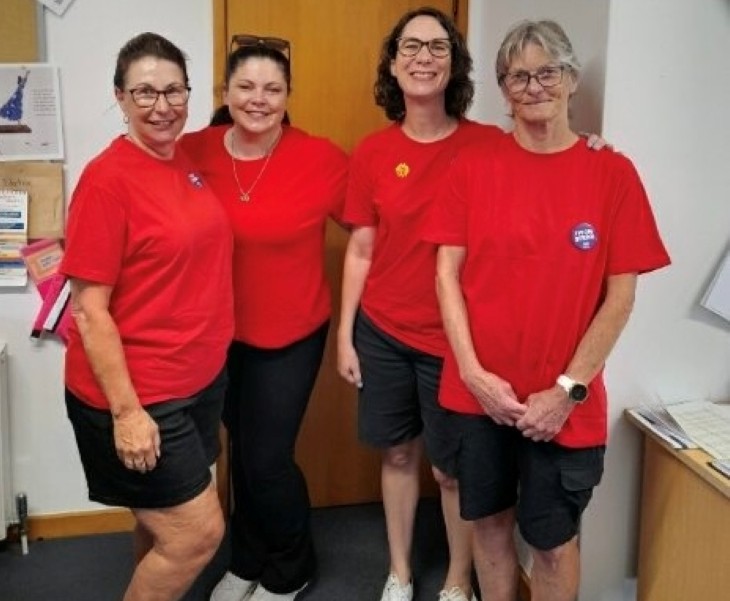
Taupō Hospital district nurses have swapped their uniforms for T-shirts for a month, from 2 February to 2 March, to expose the need for better and safer staffing.
Donning red shirts are from left to right: Deb Gretton, Rebecca Hornblow, Holly Rigby and
Marie Higgison.
Kia ora members,
Our Te Whatu Ora delegates and members had a busy week running and attending bargaining feedback meetings and holding information stalls. A big mihi to everyone involved.
Our survey seeking members’ input on the next steps for the bargaining team opened on Wednesday and runs until Tuesday evening. It outlines two possible clear directions on which we need to hear your preference.
The first direction is that the bargaining team continues to press for your claims in bargaining, and NZNO continues to campaign to support them. This would be done, if necessary, by maintaining visibility on what is needed from Te Whatu Ora and the Government through political and industrial action. This is the preference of your bargaining team.
The second direction is to move towards a collective agreement based on the current position of bargaining. This would involve the bargaining team returning to bargaining and seeking to formalise Te Whatu Ora’s current position as indicated at the latest negotiations. Members would then be asked to vote on whether to accept this new offer. If accepted, collective bargaining would be concluded for this round. If rejected, the team would head back into further bargaining, along with any necessary industrial and political action.
To quote bargaining team member and Auckland registered nurse Dawn Barrett, bargaining is now at “a turning point”. In a piece published on the Kaitiaki nursing website, she makes the salient point that “the budget given to Te Whatu Ora is a choice of this Government and does not support a safe public health system”.
So please make sure you fill in the survey and please check with your colleagues that they have also had their say. It is so important that we hear from everyone.
The bargaining team will take the results of the survey into their next negotiations with Te Whatu Ora scheduled for next Thursday and Friday. As always we will continue to try and achieve a settlement across the table. I have met with Te Whatu Ora nurses this week from Nelson/Marlborough and delegates from Waikato Hospital. Both meetings are helpful in sounding out member opinion and next steps. Please make sure any Te Whatu Ora members you know fill in the survey.
Taupo district nurses see red
One of the ways our Te Whatu Ora members have maintained pressure on Te Whatu Ora – and even had a bit of fun doing so – is through visibility strikes. They’ve now been held around Aotearoa and are currently underway in Canterbury and Whangārei.
District nurses at Taupo Hospital (see photo above) last week launched their own month-long local action. This was covered by the Rotorua Daily Post who spoke to delegate and nurse Marlene Snowden who explained they were swapping their uniforms for red T-shirts to expose “the need for better and safer staffing”.
“Despite district nurses repeatedly outlining the significant problems caused by unsafe staffing levels, including increased workload pressures, risks to staff wellbeing, and impacts on patient safety and continuity of care – these concerns have not been acted upon,” she told the newspaper.
Worker power sees parking policy reversal
Te Whatu Ora did a hasty and embarrassing U-turn yesterday on its short-lived plans to charge staff market rates for parking.
The proposed policy followed several attacks on health workers as they walked to their cars because they couldn't park at or near their workplaces. In the worst incident, a Palmerston North nurse was carjacked at gunpoint last year.
NZNO members provided strong feedback that charging health workers market rates for car parks was not the answer and would leave those unable to pay up to $100 a week even less safe.
As the NZ Herald reported, this led Te Whatu Ora to quickly reverse its plans and cut its consultation period short. NZNO will continue to push for safe, reliable and affordable parking for its members.
Student survey now finalised
NZNO's biennial student survey results have now been finalised. This follows last year’s release of interim findings, which attracted strong media interest with the shocking finding that 62% of nursing students would go overseas for work if they didn’t get a job here.
The survey gathered responses from more than 1200 students across all 21 schools of nursing and was prepared by NZNO professional nursing advisors, along with Dr Stacey Wilson from the Nursing Research Section.
Dr Wilson said the survey paints a picture of a nursing education system that is increasingly difficult to survive. For many, unpaid full-time clinical placements are the tipping point.
The full findings are available on the NZNO website.
Te Poari at Waitangi
And finally, from me this fortnight, I’d like to acknowledge the strong Te Poari presence representing NZNO at Waitangi this year. NZNO's Māori governance body makes the trip to Waitangi every February. This year they came from as far away as the Deep South.
Led by Kaiwhakahaere Kerri Nuku who spoke in the forum tent about Māori nurses having a real understanding of the weaknesses of the health system, and the concerns they have for their patients.
Te Poari members said they were hoping for change from the political front for the sake of Māori and for the health of Aotearoa. Te Poari’s Tāmaki Makaurau chair Kathryn Chapman said they also wanted to see more rangatahi getting involved in voting in this year’s election.
Have a good weekend everyone and stay dry.
Ngā mihi,
Paul Goulter, Chief Executive
Tōpūtanga Tapuhi Kaitiaki o Aotearoa NZNO
|
|
|
|
|
|
In this member newsletter |
|
|
|
|
|
|
‘We are at a turning point’ – Te Whatu Ora bargaining team |
|
|
|
|
|
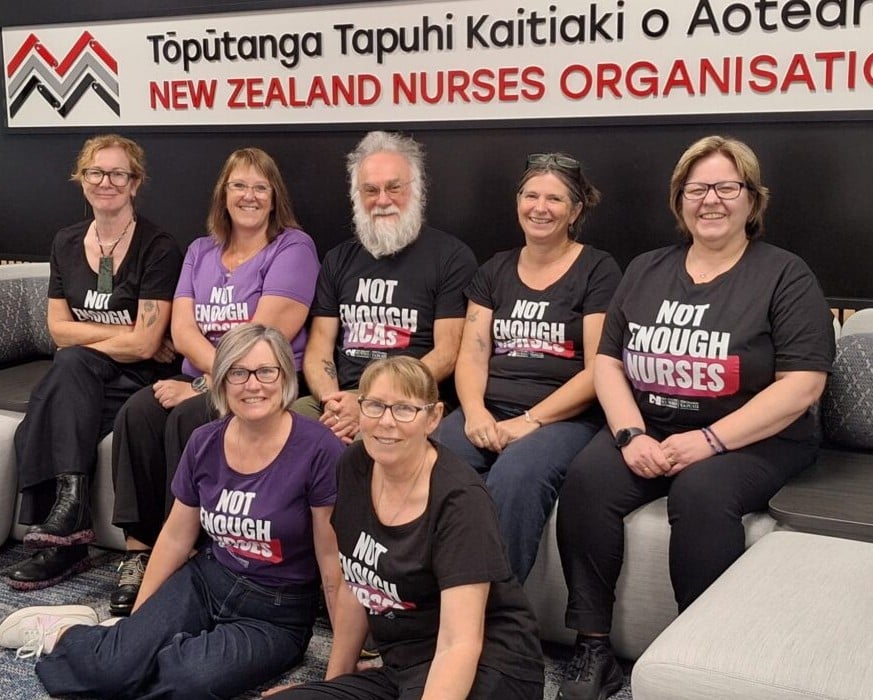
Dawn Barrett, front right, sitting with Debbie Handisides and the rest of NZNO's Te Whatu Ora bargaining team. From back left: Noreen McCallan, Glenda Huston, Al Dietschin, Rachel Thorn and Lyn Logan.
By Dawn Barrett
We are at a turning point.
We (the bargaining team) have worked so hard to make Te Whatu Ora Health New Zealand aware that a wage adjustment to support the increased cost of living, safe staffing, recognition of our senior nurses, employment of our new graduates and further cultural support for our Māori nurses are required to get an offer over the line for our membership.
We now need to know if you want to continue the fight, continue to advocate for our patients and colleagues for enforceable safe staffing, continue to say we are not willing to use our wages through a proposed pay cut in real terms and stop the voluntary and hard shifts we work everyday to prop up the public health system.
Are you still in it? We are.
The other option is to ask Te Whatu Ora for an offer to take to ratification. Currently there have been some minor wins but the key claims remain unanswered.
Please fill out the NZNO survey — emailed this week to all Te Whatu Ora members — and indicate your view of the way forward. Further engagement and industrial action like re-deployment strikes, visibility strikes and other targeted actions may be needed.
Read more in Kaitiaki |
|
|
|
|
This week we had our first meeting of the National Delegate Committee for the sector. We will meet again five more times, twice in person. The NDC will be involved in planning and supporting Primary Health activities in the sector and will have a key role to play while we’re bargaining and campaigning this year, especially as we’re in an election year.
We still have vacancies for one NDC member in each region, as advised late last year. To stand, you need to be a delegate or Te Rūnanga Representative. Our current NDC incumbents are Tracey Morgan (Te Rūnanga, Midlands), Laurie Stuart (Plunket, North), Julia Molesworth (Corrections, Central), Yolande Ernstzen (Corrections, South Island). Any delegates requiring nomination forms, email MSC on nurses@nzno.org.nz and we will ensure these are sent out. Where there is more than one nominee for the remaining vacancy, we will run an election.
The NDC has elected to have joint convenors to ensure there is a co-governance structure to this important committee. Co-Convenors leading the NDC are Tracey Morgan and Laurie Stuart.
The year started out with a flurry of bargaining. At Whakarongorau (the NZ Telehealth provider) we held three consecutive days of negotiations, eventuating in an offer that we will be putting to members once the paperwork is completed and signed off. We had amazing contributions from our delegate team, from all three unions (NZNO, PSA, NZAA) and believe we made some genuine progress for members.
We also attended a full day of mediation with Access Homecare in Auckland. Bargaining had failed to make significant progress, so we had applied for mediation prior to the Christmas break. We had a very skilled senior mediator to assist, resulting in a proposal that is currently being considered by the Access CEO and Board before being formalised as an offer. Amongst other things, this proposal included PDRP and a decent above-inflation pay increase for members. If formalised by the Board and CEO, we will present this to members as quickly as possible. We are hoping for the Access response this week.
We have been meeting internally with our campaigns team and externally with employer advocates regarding planning for the PHC MECA bargaining which will be initiated in May. We are broadly agreed that although the last bargaining round offered good pay increases, the MECA could still be better for our members. During the last round of bargaining the frustration with some employer advocates making different offers for the same collective means a fresh approach to these important negotiations is required. We are hoping to have a plan to communicate to PHC MECA members before we initiate that removes the long delays and frustrations from the old MECA processes as well as offering the possibility of genuine progress for members’ pay and conditions.
We have initiated bargaining at Sexual Wellbeing Aotearoa. We’re currently seeking member feedback, claims and nominations for the bargaining team. The claims survey closes at the end of this week, after which we will hold member meetings to endorse the claims and team.
Delegates at Corrections were asked last year to contribute to work that we have agreed as part of the settlement. We now have a definitive list. Please revisit your delegate emails from the bargaining team if you’re interested in this important work. Without you delegates, we aren’t going to make progress. |
|
|
|
|
|
|
Summerset
Our Summerset bargaining team returned to negotiations on 4 February. Although small improvements were discuss the offer is still below standard. We will attend bargaining again in two weeks to see if we can push forward a solution and will then come back to members. Since then, the company has announced change proposals at 17 Summerset sites, the proposed changes would impact both direct care and kitchen and laundry staff.
Arvida
Organisers and delegates have been responding to change proposals at 11 Arvida sites around the country. We have sent the company national feedback and Organisers are adding to this with feedback from their individual sites.
Oceania
Lady Allum, and Palm Grove and Elmwood are also undergoing a change proposals. Organisers and delegates are putting together feedback about this. One issue that arose is members, staying after their shifts to complete work unpaid. Please ensure that you are clocked in for any and all time spent working on site, so that the employer has an appreciation of all you do for residents.
Age Safe training
The endless reduction of rostered hours in aged care won’t stop on its own. It’s built into the way the sector is funded. If we want secure hours and safe care, we need two clear changes:
- A funding model that reflects the real cost of quality and culturally safe care
- Mandatory minimum staffing levels in legislation, so employers can’t keep cutting to the bone
Without those protections, working hours will continue to shrink and residents will continue to feel the impact.
This training will help aged care delegates to:
- Understand the Manaaki i te raru | Care in Crisis report and what it means in practice
- Explain its findings and solutions clearly to your workmates
- Organise coworkers and communities to push for the changes we need.
We will be holding Age Safe training on the following dates for aged care delegates:
18 March in Hamilton
19 March in Christchurch
24 March in Wellington.
26 March in Auckland
Please contact Tessa.Lampitt@nzno.org.nz if you are keen to participate.
|
|
|
|
|
|
|
Pay equity in the non-Te Whatu Ora sector |
|
|
|
|
Working Women’s Week: Vote Pay Equity
Working Women’s Week (2–8 March) is a nationwide call to vote pay equity making women’s work visible, valued, and politically unavoidable in an election year. Across unions and communities, it’s about showing that the work women do every day is essential, skilled, and long overdue for fair recognition.
Working Women’s Week is about turning shared experience into collective pressure.
👉You can see what’s happening nationally, and how to get involved, here
A recent Spinoff article by Marilyn Waring captures this powerfully. Writing about librarians, she describes work that is relied upon, deeply skilled, and overwhelmingly done by women yet treated as expendable when funding is tight.
NZNO members will recognise this story immediately. Our work holds communities together, but undervaluation shows up in pay gaps, shortages, burnout, and pressure on care.
Read the article here
Working Women’s Week is about turning shared experience into collective pressure.
👉 You can see what’s happening nationally, and how to get involved, here.
NZNO Pay Equity Update: Strategic Action under Maranga Mai Rise Up!
NZNO’s pay equity work is our contribution to this national movement. It sits within Maranga Mai Rise Up! using pay equity deliberately to challenge the systemic undervaluation of heath care and to shift funding, political, and workforce settings.
Under the amended pay equity law, NZNO is taking a careful, strategic approach. Current claims at Plunket and Hospice have progressed intentionally, and in both NZNO has been able move through the initial stages of the process. As the claims progress, they are helping us understand the new law, where alignment with employers supports progress, and where the system starts to limit outcomes. This learning strengthens future claims and the wider campaign.
Read more |
|
|
|
|
|
|
Private hospitals and hospice sector |
|
|
|
|
Nominations for our new National Delegates Committee closes on 13 February 2026. We will review the outcome early next week.
Private Hospitals
ABI & Evolve Rehab
The parties met for negotiations on 11 – 12 February and will meet again on 16 – 17 March. A joint communication will be sent by the parties about negotiations shortly.
Allevia Kensington
Negotiations will be held on 17 - 20 February.
Braemar
Join us at face-to-face meetings to discuss the company’s offer on 19 – 20 February.
All meetings will be held in the upstairs meeting room. Meetings are one hour, unless otherwise stated.
-
Wednesday 19 February: 10am – 11am, 2pm – 3pm, 4pm – 5pm, 6pm – 7pm and 10.15pm – 10.45pm
-
9am – 10am, 11am – 12 noon, 2pm – 3pm, 4pm – 5pm
Crest
We have ratified our collective agreement.
Grace
We ran report back meeting on 9 February to discuss the company’s offer and received strong feedback from members. We are discussing outstanding issues with the employer and aim to provide an update next week.
Hospice
Cranford Hospice
Members ratified their offer earlier this year, which provides minimum 7% increase over 22 months.
Hospice Southland
Negotiations are continuing.
Hospice MECA (Rotorua, Taupō, Eastern Bay of Plenty, Marlborough)
Negotiations will be held on 24-25 March.
Four Hospice MECA (Waikato, Waipuna, Mary Potter, Harbour Hospice)
Negotiations will be held on 26 February.
Hospice Whanganui, North Haven Hospice, Mercy Hospice
Plans are underway to get last year's negotiations started.
Private Health
New Zealand Clinical Research (NZCR)
We are going to mediation on Thursday, 27 February. |
|
|
|
|
Our leaders speak: Kaiwhakahaere Kerri Nuku – We know what to do and how to do it! |
|
|
|
|
My whakapapa recognises Maungaharuru, the mountain renowned for its distinctive roaring sounds—a legacy of the diverse avian populations that once inhabited the area. Maungaharuru holds spiritual significance for the hapū Ngāti Kurumōkihi, who serve as its kaitiaki (guardians).
Aotearoa retains numerous sites of substantial cultural importance. For example, Haruru Falls (“big noise”) in the Bay of Islands has profound connections to Māori whakapapa. The falls feed into the Waitangi River, which then supplies a major lagoon adjacent to Te Tii Marae and the Waitangi Treaty Grounds.
Each year, I travel to Waitangi, a location of historic significance where our ancestors signed an agreement in 1840. The landscape is visually impressive, yet it is the enduring spirit of the place that stands out. This year’s commemoration of Te Tiriti o Waitangi brought together both Tangata Whenua and Tangata Te Tiriti, facilitating whanaungatanga through discussions and activities that underscored the document’s ongoing relevance.
I was privileged to present in the Forum tent at Waitangi, a venue for substantive political discourse where leaders are held accountable before our community. My focus this year was on Ōhanga (Economics), examining the persistent gap whereby economic advancement does not necessarily translate into broader benefit.
Despite commitments from the Government to restore economic stability, data indicate significant challenges remain. Over the past year, there have been 1533 redundancies within the public service. The repeal of Fair Pay Agreements has stalled progress on improved compensation and working conditions for lower-wage workers and resulted in the discontinuation of 33 Pay Equity claims. These claims had the potential to address sex-based discrimination impacting over 150,000 workers in female-dominated professions such as nursing, teaching, and social work, and were valued at an estimated $12.8 billion over four years.
Cost-of-living pressures continue to intensify. Indicators show rising homelessness, escalating housing costs, increasing poverty, and widening wage inequality. According to a July 2025 Salvation Army report, approximately one in every 1000 New Zealanders lacks adequate shelter, with 57,000 women affected by homelessness. Early 2025 statistics reveal that one in seven children live in households experiencing material hardship. Moreover, over half of Māori individuals reside in highly deprived areas, and one in four Māori children encounter material hardship. Budget 2025 reduced funding by roughly $1 billion for targeted Māori programmes and housing initiatives.
New Zealand also confronts the implications of an ageing population. While life expectancy is improving, additional years are often spent in poor health with multiple comorbidities. The demographic transition is reducing the relative size of the working-age population required to generate income tax revenue to support older citizens. In 2025, there were four working-age individuals for each person over 65; projections suggest this will fall to two by 2065. Addressing these demographic challenges necessitates investment in health workforce development and retention, enhancements to health services, and reforms to the tax system to sustain the needs of an ageing society and minimise the risk of a youth exodus.
There has been an unprecedented departure of New Zealand citizens. In September of the previous year, international departures increased by 8% compared to the year before, accounting for nearly 73,000 people leaving the country—almost 40% of whom were aged 18–30. Furthermore, in 2024, nearly 12,000 New Zealand registered nurses sought registration to practice in Australia.
We need to keep having conversations, persistently questioning, and advocating for what truly matters—our people, our whenua (land), and te taiao (environment). Stay united in our efforts.
I acknowledge those impacted by the Mauao landslide and offer my respects to Ngai Te Rangi. |
|
|
|
|
|
‘It’s not resilience we’re short of – it’s support’ |
|
|
|
|
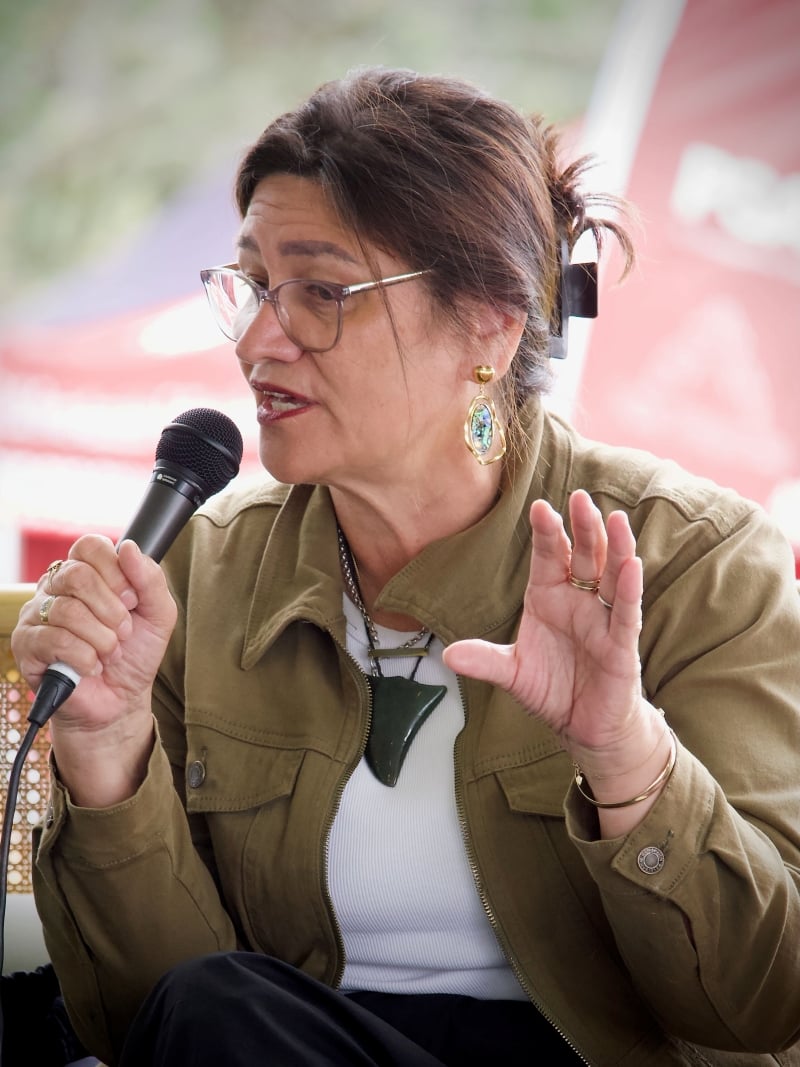
By Stacey Wilson
Nursing students across Aotearoa New Zealand are clear about one thing: they want to be nurses. They are committed, motivated and proud to be entering the profession. But the findings of the 2025 National Nursing Student Survey show that many are being asked to carry levels of financial, emotional and physical pressure that are simply unsustainable.
The survey, conducted by Tōpūtanga Tapuhi Kaitiaki o Aotearoa New Zealand Nurses Organisation (NZNO), gathered responses from more than 1200 students across all 21 schools of nursing. What emerges is not a story of students who lack resilience, but of systems that are increasingly difficult to survive.
This is not just an education issue. It is a workforce issue. And it is a call to action for the nursing profession as a whole.
Placement poverty is shaping who becomes a nurse
For many students, clinical placements are the tipping point. Unpaid full-time placement blocks, combined with costs for travel, parking, accommodation and childcare, push students into significant financial hardship. “I work 30 hours a week just to survive. Then placement starts and I’m expected to work 40 hours unpaid.” Nearly two-thirds of students reported frequently struggling to afford essentials like rent, food and transport. More than half said they had seriously considered leaving their nursing programme because of money pressures.
Students described being told to “just not work” during placement — advice that ignores the realities of the cost of living and the responsibilities many students carry. “Being told to ‘just not work’ during placement isn’t realistic when you still have rent, food and kids.” This is not a personal failing. It is a structural problem that shapes who can enter and remain in nursing.
Read more in Kaitiaki |
|
|
|
|
|
|
Grow yourself professionally by joining NZNO's colleges and sections |
|
|
|
Colleges and sections are central to NZNO’s success and influence and brings together groups of members who are focused on a specific nursing specialty.
So far only less than 20% of members have elected to join a college or section, and we'd like to see you grow that number. NZNO colleges and sections can help you advance your practice through policy and professional development opportunities, and membership at most colleges and sections is open and free to NZNO members.
There’s bound to be one for every member as there are 20 colleges and sections across a range of specialty areas and members can choose to belong to as many as three. Individual membership choices are usually related to clinical specialty and/or study and research interests.
Check out our colleges and sections here. Which one(s) will you join? |
|
|
|
|
College of Stomal Therapy Nurses Conference - upcoming conference: 'Resilience' |
|
|
|
|
Venue: Novotel Christchurch Airport
Date: Thursday 5 March – Friday 6 March 2026
This conference brings together nurses, specialists, educators, and industry partners who are passionate about improving the lives of people living with a stoma.
This year’s theme, Resilience, highlights the ability of both patients and clinicians to adapt, recover, and grow — strengthening stoma care for all. Resilience is found in the courage of our patients, the dedication of our teams, and the ongoing commitment to innovation and compassionate care.
Link to the conference page, which includes the programme and registration: Home - NZNO College of Stomal Therapy Nursing Conference 2026
Registration is at the reasonable cost of $200 for the two-day event, or $120 for a single day, and includes the conference dinner.
Find the programme here
Event flyer |
|
|
|
|
The next NZNO Maranga Mai! funding round opened on 31 December 2025 closing end of March 2026.
This grant is available to all NZNO financial members and is awarded annually.
The purpose of this fund is to provide members with assistance for professional development activities to enhance health care outcomes/provision in Aotearoa /New Zealand.
The fund is available for a variety of activities such as short courses, conferences, seminars, postgraduate and undergraduate study, workshops, books and travel. Other course related costs may be considered.
The fund is not available for any mandatory training required by an employer which is the employer’s responsibility to provide or fund.
The amount of any grant is determined by the Committee and will be decided based on total fund amount available once all applications are assessed.
You can apply through the Maranga Mai! online form on the NZNO Scholarships and Grants webpage.
|
|
|
|
|
|
|
MPs urged to vote down anti-worker law |
|
|
|
|
A collective of 49 unions, lawyers, NGOs, academics, former Workplace Relations Ministers, and current spokespeople have co-signed an open letter calling on all Members of Parliament to vote against the Employment Relations Amendment Bill, currently before the House.
“These changes threaten every single worker in Aotearoa. This is the most anti-worker Bill we’ve seen in decades,” said NZCTU Te Kauae Kaimahi President Sandra Grey.
“Working people have a basic right to seek remedies for unjustifiable and unlawful dismissal. This Bill effectively destroys that right, leaving workers completely exposed to abuses of power by their employers.
“The Bill also allows employers to misclassify employees as contractors, and to strip them of basic entitlements like holiday pay and sick leave. This has the potential to undermine worker rights completely in some industries and will lead to the destruction of rights in many others over time.
“This Bill was clearly opposed during the select committee process, with employment experts and working people signalling that it will dramatically worsen an imbalance of power that already benefits employers. The majority of the submissions on the Bill were against it.
“We are asking every Member of Parliament to listen to the public, experts, and those impacted most by these changes, and vote this Bill down at the next reading.
“This dangerous Bill must not proceed,” said Grey.
|
|
|
|
|
|
|
ICN’s call for International Nurses Day 2026 |
|
|
|
|
ICN has announced the theme for International Nurses Day (IND) 2026: Our Nurses. Our Future. Empowered Nurses Save Lives.
This focus sends a clear message that to maximize the full life-saving impact of the nursing workforce, we must empower nurses with safe, fair work environments and full nursing practice, influence, and leadership. The theme comes at a critical time, as global health faces unprecedented challenges from workforce shortages, rising health care demands, and increasing effects of conflict and climate change.
Nurses continue to sustain care, protect communities, and hold health systems together, often under immense strain, but their work is often not fully recognised or supported.
José Luis Cobos Serrano, ICN President, emphasized the urgency of this year's message:
"We chose this IND 2026 theme because it recognises that in this moment of intense global pressure, every day, all around the world, nurses are doing extraordinary work to both save and improve the lives of individuals and entire communities.
Read more |
|
|
|
|
Survey on the use of Artificial Intelligence (AI) in lung cancer screening
We are looking for nurses working in primary health care, respiratory, or oncology in Aotearoa New Zealand to take part in a short (15 min) survey of their views on the use of AI in lung cancer screening.
AI will inevitably be part of a national lung cancer screening programme, however for implementation to be successful, its use has to be acceptable to both recipients and those delivering the screening.
Give your views and help us plan for lung cancer screening in Aotearoa New Zealand here.
This research is funded by the Health Research Council of New Zealand (HRC), with research team members based at the University of Otago/Ōtakou Whakaihu Waka and Health NZ/Te Whatu Ora.
This study has been approved by the University of Otago Human Ethics Committee (Health) - Te Pae Matatika Tangata (Hauora), Otakou Whakaihu Waka (Ref H25/0473).
|
|
|
|
|
|
-
US hospital accused of union-busting, judge rules in favor of nurses unionUS, nurses.org, 10 February 2026
- Nursing left behind on pay progression, RCN report warns
UK, RoyalCollegeofNursing, 18 December 2025
- LA nurses to hold strikes beginning Feb. 19
US, NNU, 10 February 2026
- What nurses should know about preventive care conversations
US, Medical News Bulletin, 10 February 2026
-
|
|
|
|
|
|
|